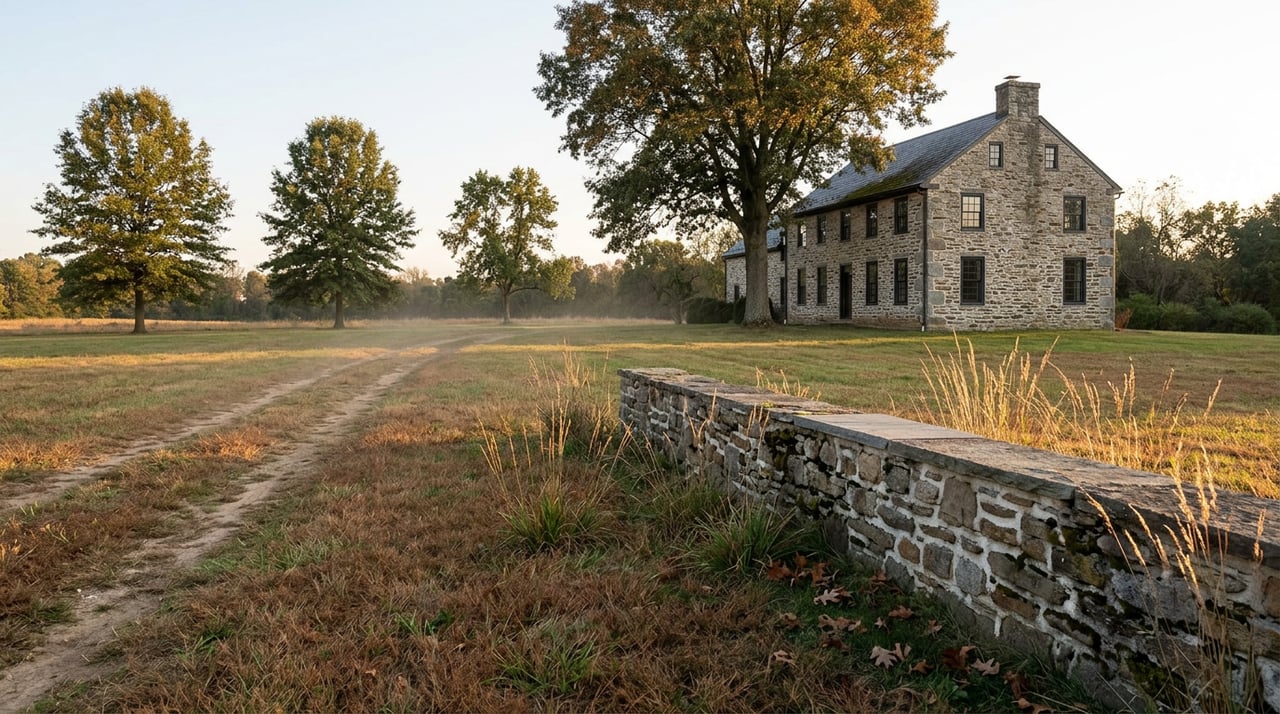
In February 2026, the Maximuck family's farm market at the corner of Long Lane and Street Road became permanently unbuildable. The 102-acre property, worked by the same family for more than six decades, now carries a conservation easement that runs with the land forever. No future owner, no matter what they pay, can subdivide it.
Board of Supervisors Chair Maggie Rash marked the moment by noting that Buckingham had just added to its farmland already protected, calling Maximuck's "a decades-old farm market that serves the community." It's a good story about a beloved farm. It's also the wrong story if you're trying to understand what it means for you as a buyer, a builder, or a family comparing Buckingham to the townships around it.
The real story isn't that Buckingham is running out of land. It's that Buckingham decided, back in 1975, exactly where the growth it couldn't stop would go instead. Every acre locked up in a preservation easement or an agricultural zone has a counterpart somewhere else in the township, engineered to absorb more density than it otherwise could. If you're evaluating a property here, the question isn't whether Buckingham still has room to build. It's which side of that trade your parcel sits on.
The Trade Nobody Explains on a Listing Sheet
Buckingham is the largest township in Bucks County, covering roughly 33 square miles of rolling farmland, stone farmhouses, and a scattering of newer subdivisions. In the early 1970s, the township was losing farmland fast enough that its 1974 Comprehensive Plan made preservation the priority, and a 1975 zoning ordinance backed that plan with teeth: it replaced blanket one-unit-per-acre zoning with a system that split the township into agricultural districts and development districts, then let landowners in the agricultural zones sell their unused development rights to landowners in the development zones.
That system is still in force, amended in 1994 to sharpen how it works. Today, the township's AG-1 and AG-2 agricultural districts, which together cover more than half of Buckingham's land area, carry a by-right density of one unit per 1.8 acres. A landowner who wants to develop on-site can cluster homes on less than half a parcel without adding units. But a landowner who instead sells development rights off the property, through the township's Transfer of Development Rights program, can permanently preserve the land while pocketing value that would otherwise have come from building on it. Properties of 25 acres or more qualify to sell.
Those rights don't disappear. They land in specific places: the township's Planned Business and Residential District and Village Residential-3 District can more than double their base density, from five units per acre up to 15, by absorbing transferred rights. The R-1 Residential District can add 40 percent more density through a cluster subdivision using TDR. Village Residential-1 can double its maximum density the same way.
This is the part a median price or a days-on-market number will never tell you. Buckingham's development capacity didn't shrink when a farm got preserved. It moved.
Where the Redirected Density Is Landing Right Now
You can see the mechanism working in real time by looking at what's currently in front of the township's planning staff. As of the most recent update to Buckingham's public development log in December 2025, three active proposals show where growth is actually concentrating:
- The Estates at Furlong, a revised plan filed in September 2025, proposes 17 single-family homes on a 13-acre site fronting Route 263 at 3178 York Road.
- A McKee Group tract adjacent to the existing Buckingham Springs community proposes development on a 79-acre parcel with frontage along Durham Road (Route 413), Lower Mountain Road, and Creek Road.
- A Wycombe Vineyards minor subdivision would carve one new two-acre lot from a 50-acre parcel for a single-family home, taking access from a new driveway on New Hope Road.
None of these sit in the middle of open agricultural land. Each one attaches to an existing development node, a state route, or a community that's already built out. That's not coincidence. It's what a 50-year-old zoning trade looks like when you watch it play out on a live map instead of reading about it as history.
What a Buckingham Zoning Line Tells You That the Listing Won't
If you're comparing a Buckingham property to something in Doylestown or New Hope, the zoning district matters more here than in almost any other Bucks County township, because it tells you whether the parcel next door is legally capable of changing.
- Check whether the parcel sits in AG-1 or AG-2. If so, ask whether it carries a recorded conservation easement. An easement filed with the Bucks County Recorder of Deeds is permanent. It survives every future sale.
- Look at parcel size relative to 25 acres. That's the threshold for TDR eligibility. A 40-acre agricultural parcel next to your target home is a candidate to sell development rights and stay open forever. A 4-acre parcel isn't eligible for that path at all.
- Ask what zoning district actually applies, not just what the township looks like from the road. A property that reads as rural on a drive-by can sit inside a receiving zone capable of much higher density than its current use suggests.
- Request the township's current subdivision and land development log before you write an offer near open land. It's public, and it tells you what's already in motion nearby, not just what's zoned in theory.
- Don't assume "preserved" and "undeveloped" mean the same thing. Land that looks like a working farm today can still be a receiving site if it sits in the right district, and land that looks ripe for a subdivision can be permanently off the table if an easement is already on file.
The Number That Actually Moves in This Market
Across Bucks County, homes sold at a median price of $538,000 over the three months ending in May 2026, up 7.5 percent from the same period a year earlier, with most homes finding a buyer within about three weeks. That's the backdrop every township in the county is competing against.
Buckingham's version of that story isn't a shrinking pie. It's a pie that got sliced by policy decades before today's buyers showed up. The total buildable capacity in the township hasn't collapsed. It's just permanently divided between land that will never add another unit and land that was specifically zoned to take on more than it otherwise could. A buyer who understands which side of that line a property sits on is negotiating from a fundamentally different position than one who's just comparing square footage and lot size.
A Couple of Questions We Hear Often
If my neighbor's farm is in an agricultural zone, could it still be developed later? It depends entirely on whether an easement has been recorded. Agricultural zoning alone doesn't guarantee permanence. An easement filed with the county does. The two are easy to confuse and worth verifying separately before you assume either way.
Does this mean I can't find land to build on in Buckingham? No. It means the land available to build on tends to cluster in specific receiving zones and along specific corridors rather than appearing evenly across the township. Knowing which districts those are narrows the search considerably.
Buckingham rewards buyers who read the zoning map as carefully as they read the listing photos. If you're weighing a property here against something in a neighboring township, or trying to understand what a parcel's district designation actually means for its future, the Lisa Povlow Team can walk the specifics with you. Schedule a private consultation.