
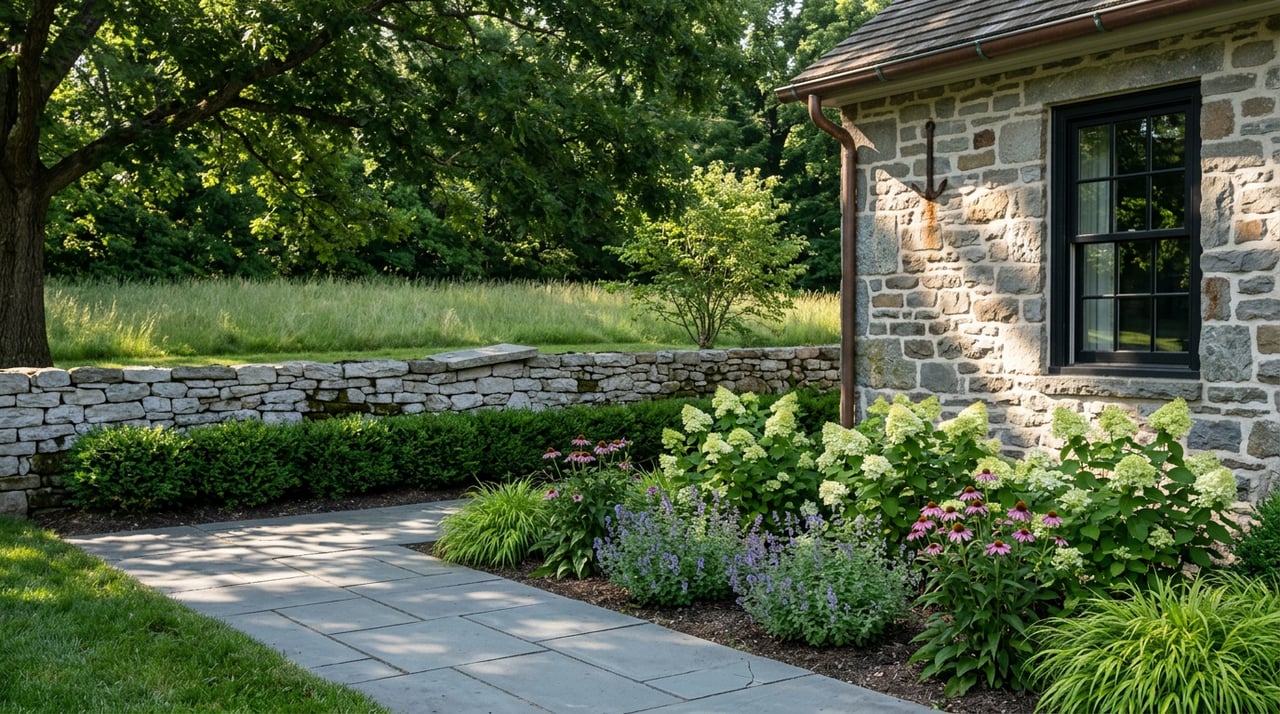
A buyer touring Solebury this spring found a listing described as five wooded acres with a small farmhouse. On paper it looked like a candidate for expansion, maybe a second dwelling for a parent. The title work told a different story. The development rights had been sold to the township years earlier, co-held with a private land trust, and the easement recorded in the chain of title forbade any further subdivision. The house could be renovated. The land could not be split. The buyer walked.
This is the transaction that defines Solebury more than any median-price chart. Before you compare Solebury to Buckingham or Doylestown on a portal, you have to understand that a large share of the township's land has already been taken out of the development pipeline permanently, and that the homes still trading are the ones the pipeline can no longer replace.
What the portal median doesn't say
Statewide numbers set the baseline. In May 2026, the Pennsylvania median sale price was roughly $318,867 with a median of 36 days on market and a 98.9% sale-to-list ratio, according to Redfin's Pennsylvania housing market report. A separate May 2026 read from Houzeo put statewide months of supply at 0.59 and average days on market at 50.
Solebury sits in a different weight class.
| Metric | Pennsylvania (May 2026) | Solebury (recent) |
|---|---|---|
| Median list / sale price | ~$318K–$330K | ~$960K–$971K trailing sale median; multi-million list median on active inventory |
| Days on market | 36–50 | 80–84 on trailing sales; 162 average on May 2026 active list |
| Active listings | ~10,000+ | Frequently in the low double digits |
The trailing 12-month sale median in Solebury sat near $960,000 as of mid-2025, up roughly 12% year over year on one-story homes and roughly 20% on the broader inventory. Active-list snapshots in spring 2026 showed just a handful of homes listed at a time, with a median list price above $3 million and average marketing periods stretching past five months.
The obvious read is that Solebury sells more expensive houses. The more useful read is that Solebury sells fewer houses, of a narrower type, and each transaction takes longer because the pool of replacements is capped by law.
Why the supply is locked
Solebury has been buying itself out of the development market for almost thirty years. Since 1998, the township has preserved 89 properties covering 3,868 acres, an area that represents roughly 38.5% of the 17,376 acres inside the township line, according to Solebury Township's Land Preservation program.
That preservation was funded deliberately, not accidentally. In 1996, 1999, 2002, 2005, and 2019, residents approved bond referenda authorizing up to $56 million for easement purchases, passing by an average of roughly 90%. The Township partners with the Land Trust of Bucks County and Heritage Conservancy to co-hold conservation easements, and with the Bucks County Agricultural Land Preservation Program on farm easements. The Aquetong Valley Preserve alone represents more than 900 acres protected after landowners along the corridor donated easements collectively.
The pipeline is still active. In October 2025, the Solebury Board of Supervisors approved a $600,000 purchase of a conservation easement on the 30.6-acre Paxson Hill Farm at 6764 Paxson Road, a property with a documented history back to the late 1600s Paxson family. That transaction removed another 30 acres from the potential subdivision map for good.
Two features of these easements matter for the buyer:
- They are perpetual. The restrictions run with the land and bind every future owner.
- They are recorded. The easement appears in the deed record, and the property is subject to annual compliance monitoring by the co-holding organizations.
For a buyer, this is not a background fact about township character. It is the reason the parcel you are looking at behaves the way it does at closing.
What the RA district actually allows
The land that is not under easement is still constrained. Most of Solebury sits in the RA, Residential/Agricultural District, whose stated purpose in Chapter 27 of the township code is to preserve the character of existing residential and agricultural areas.
The dimensional requirements in RA:
Minimum lot area: five acres. Minimum lot width at building line: 300 feet. Minimum lot width at street line: 250 feet. Minimum front and rear yards: 125 feet each. Minimum side yards: 75 feet. Maximum impervious coverage: 40%. Maximum building coverage: 15%. Maximum building height: 35 feet.
On top of RA, three overlays are common in the township: Floodplain Conservation, Steep Slope Conservation, and Carbonate Geology. Any of them can shrink the buildable envelope inside an otherwise conforming lot. The Subdivision and Land Development Ordinance separately requires new residential projects to set aside 30% to 50% of land as open space, often via perpetual easement.
A few practical consequences follow. A five-acre parcel is the floor for a new single-family lot in RA, not a typical parcel. A "buildable" listing that pre-dates the 1988 zoning ordinance may be a nonconforming lot that is still buildable under a specific exception, but it cannot be enlarged by consolidation into conformity. Water is almost always by private well, and Part 29 of the code requires a drilled, cased, and grout-sealed well producing at least six gallons per minute, with a potability certificate delivered before the building permit issues.
Inside a Historic District, a certificate of appropriateness is required for exterior work whether or not a zoning permit is triggered. That is a scheduling fact, not a philosophical one. It sits between contract and closing.
Five checks before you write an offer
If you are buying land or a legacy property in Solebury, the diligence work is different from what a comparable price point in a less-constrained township would require. The following belong on the list before the offer, not after inspection.
- Pull the easement record. Ask your title company to confirm whether any conservation, agricultural, or facade easement is recorded against the parcel, and who co-holds it. Easements co-held by the township, the county, Heritage Conservancy, or the Land Trust of Bucks County each carry their own monitoring and consent requirements.
- Confirm the lot's zoning status. In RA, verify whether the parcel meets the five-acre minimum and the 300-foot width at the building line, or whether it qualifies as a pre-1988 lawful nonconforming lot. That distinction changes what you can build and how you can expand.
- Check the overlays. Floodplain, Steep Slope, and Carbonate Geology overlays each reduce the buildable footprint. A large lot on paper can carry a small usable envelope in practice.
- Read the accessory dwelling language against the deed. RA allows accessory dwellings by conditional use, but not on lots restricted by prior deed, plan, or operation of law. If the parcel was part of an earlier subdivision, that door may already be closed.
- Order the well test early. A six-gallon-per-minute yield is the code threshold, not a suggestion, and lenders will care about it. Rural properties along carbonate geology corridors are worth testing sooner rather than later.
None of these are optional in Solebury. They are the reason two houses at the same list price can behave very differently at closing.
The market takeaway
The gap between Solebury and the rest of Pennsylvania is not primarily a story about luxury finishes. It is a story about a jurisdiction that spent thirty years, five voter referenda, and $56 million in bonding authority to make sure the supply of new lots would not grow. The market you are shopping in 2026 is the direct output of that policy. Prices are higher because the pool of substitutes is smaller. Days on market are longer because each remaining house is idiosyncratic and its buyers self-select. And the diligence work carries more weight because a meaningful share of what looks like land on a listing sheet is, legally, something else.
For a buyer who understands that mechanism, Solebury becomes easier to price, not harder. The valuation questions are specific and answerable. The friction is in the record, waiting to be read.
Frequently asked questions
Does a conservation easement lower the value of a Solebury home I might buy? Not in any predictable way. The easement removes development rights, which reduces the theoretical value of the underlying land. It also permanently protects the character of the property and its surroundings, which is often what draws buyers to Solebury in the first place. The right answer is parcel-specific and belongs in a conversation with an appraiser who has worked with eased properties in Bucks County.
Can I build an addition or a pool on an eased property? Sometimes. Easements are individually written, and most permit continued residential use of the existing dwelling and reasonable accessory improvements within a defined envelope. The co-holding organization reviews proposed changes. Read the recorded easement text, not a summary, before you plan work.
Is new construction possible in Solebury today? Yes, on qualifying lots. Most new single-family construction happens on pre-existing lots of record or through the RD and RD-C conservation-cluster districts, which trade smaller lot sizes for larger set-aside open space. Fully new five-acre RA lots are rare because the underlying land has largely been preserved, subdivided long ago, or is already built on.
If you are weighing a Solebury purchase and want the easement, zoning, and overlay picture on a specific parcel before you write an offer, the Lisa Povlow Team is glad to walk the record with you. Schedule a private consultation.